
Resources
Today’s Students Coalitions’ federal policy resources include the most current data on adult students, parenting students, college affordability, equity, and more. Our work has resulted in positive change for today’s students, including access to discounted broadband for Pell students, the establishment of emergency aid funds, and increased financial aid for parenting students.
Fact Sheet on Student Caregivers
Research on student parents and their unique challenges commissioned by Higher Learning Advocates. Nearly a quarter of today’s students are parents, and they have unique time constraints because they must balance caregiving, school work, and employment. Student parents are more likely to be older, more likely to have a low-income, and more likely to work…
What Works for Today’s Students—Satisfactory Academic Progress Reset
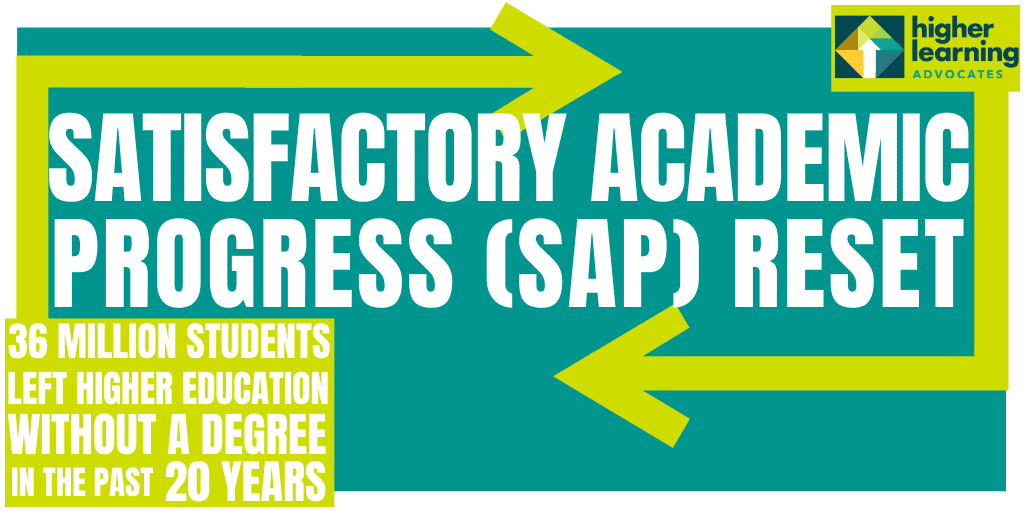
Over the past 20 years, 36 million students have enrolled in higher education but have not finished a degree. Although today’s students are completing college at higher rates than before, four out of ten students still do not earn a degree within six years. Download our new policy brief, What Works for Today’s Students—Satisfactory Academic Progress Reset,…
Higher Learning Advocates Submits FY21 Priorities to House LHHS Committee
WASHINGTON (March 23, 2020) — Today, Higher Learning Advocates submitted testimony before the U.S. House of Representatives Labor, Health and Human Services, Education, and Related Agencies (LHHS) Appropriations Subcommittee addressing funding for the U.S. Department of Health and Human Services and Education for FY 2021. Higher Learning Advocates urged the subcommittee to make significant investments…
Serving Students Screener
College is supposed to be a path towards upward social mobility for all students, yet our current higher education system has significant room for improvement when it comes to advancing opportunity for today’s students, including low-income students and students of color. It is more important than ever that proposals to improve our nation’s higher education…
101: Part-time Students
Today’s students are more diverse than previous generations. Twenty-four percent are parents, 37 percent are older than 25, 49 percent are financially independent, and 42 percent are students of color. About 40 percent of today’s students attend part-time. For more background information on part-time students download 101: Part-Time Students. This 101 details who part-time students…
Policies Impacting Today’s Part-Time Students
Today’s students are more diverse than previous generations. Twenty-four percent are parents, 37 percent are older than 25, 49 percent are financially independent, and 42 percent are students of color. About 40 percent of today’s students attend part-time. Unfortunately, the current higher education system — and the policies that govern it — can result in…
Stackable Credentials Backgrounder
Author: India Heckstall Today’s students are more diverse than previous generations—they are more likely to be workers, parents, and returning adults—and do not always follow a single and consistent path to employment. As our current workforce requires lifelong learning and re-skilling, individuals now require multiple entry and exit points through postsecondary education and the workforce,…
What Works for Today’s Students—Microgrants
Currently, only about half of students who enroll in college graduate within eight years of beginning their studies. Microgrants can help to increase this number. Download our new policy brief, What Works for Today’s Students—Microgrants, to learn more about how microgrants are working to support today’s students, the challenges institutions encounter in funding emergency grant…
State Profiles
State profiles feature key data points, visual infographics, and brief explanations of all 50 states, and are a quick and easy resource for policymakers, analysts and media.