Pathways Allow Students Freedom
Intentional pathways in higher education allow students freedom — to continue learning, to grow in their careers, to work toward and actually attain the American Dream. But higher education success is not equally accessible to all students.
For many students, particularly first-generation college students, working learners, adult learners, and students from historically underserved communities, the journey through higher education is often accompanied by financial pressures, unfamiliar institutional systems, competing responsibilities, and uneven access to guidance and support.
Diverse Pathways Can All Lead to Success
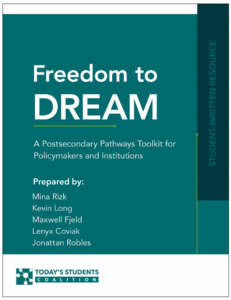
Written by undergraduate students as part of TSC’s Student Ambassador Fellowship program, the Freedom to Dream Toolkit explores a range of policies, programs, and institutional strategies designed to strengthen student pathways to success and improve educational outcomes. The toolkit highlights approaches that help students transition more successfully into higher education, receive credit for prior learning and lived experience, access meaningful academic advising and financial aid guidance, and navigate college with stronger systems of support. By intentionally creating space for students’ perspectives, the toolkit offers policymakers and institutions of higher education valuable insights on opportunities to:
- expand access to dual enrollment programs
- strengthen federal investment in support services for first-generation students
- improve financial literacy education
- develop tailored advising systems that better respond to the diverse experiences and goals of today’s learners
Together, the policy areas explored reflect a broader commitment to creating student-centered systems that recognize diverse pathways can all lead to success when support aligns around learner need.
The Freedom to Dream Toolkit, from the perspective of college students, is intended to serve as both a resource and a call to action. The policies and practices explored throughout these pages demonstrate that meaningful progress is possible when institutions and policymakers prioritize equitable access, proactive support systems, and student-centered design.

After three years as a Marine Corps helicopter mechanic, I assumed my experience would count toward my civilian Airframe and Powerplant (A&P) license. But in 2014, almost none of my service hours transferred, and going back to school full-time wasn’t financially feasible for me.
— TSC Student Ambassador Fellowship Alum, Jonattan Robles, on credit for prior learning
Related Resources
Please find the related resources to the post above.
-
Students Speak Out
A digital campaign toolkit to participate in our national community -
Credit for Prior Learning (CPL) Backgrounder
How Credit for Prior Learning (CPL) Can Benefit Today’s Students -
Student Well-Being First Toolkit
A student-written toolkit for institutions and policymakers